When Should You Choose Hot Finished Tubes Over Cold Drawn Tubes?
21/ Jul, 2026
Two seamless tubes, same grade, same size on the enquiry. One is noticeably cheaper. The other has a bright surface you could machine straight off, and tolerances tight enough to drop into a hydraulic assembly without a second thought. Most buyers assume the cheaper one is the compromise. Sometimes it is. Very often it is not.
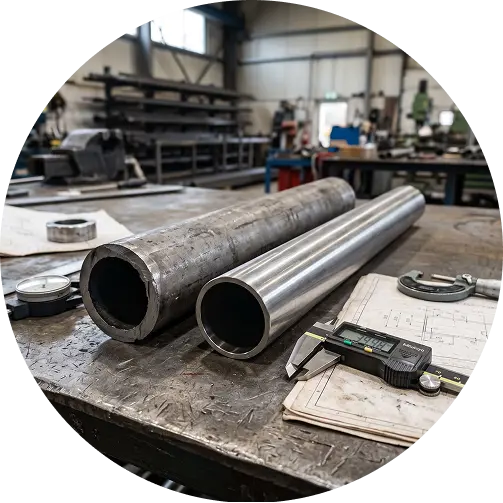
The difference between them is not the steel, and it is not how the hollow was formed. Both start the same way, pierced from a solid bar. What separates them is what happens next, at the finishing stage, and that one step decides your tolerances, your surface, the internal stress in the tube, your cost per metre, and even which sizes you can get at all.
This is worth getting right, because a wrong call costs you in both directions. Over-specify and you pay a premium for precision your job never needed. Under-specify and you are paying for machining and rework later, or discovering the tube was never suited to the load in the first place.
We get asked about this a lot, so this guide sets hot finished tubes and cold drawn tubes side by side and gives you a straight answer on when each one is the right buy.
What Are Hot Finished Tubes?
Before you can judge which tube suits your project, it helps to know what "hot finished" actually describes, because the name refers to a stage of manufacturing, not a type of steel. A hot finished seamless tube is one that receives its final size and shape while the steel is still hot, above its recrystallisation temperature. That single fact explains everything else about how the tube behaves: its stress levels, its tolerances, its surface, and the sizes you can buy it in. Here is how it is made and what that means for you.
How the Process Works
It begins with a solid round bar, heated until it is glowing and workable. That bar is then pierced, typically by cross roll piercing, where the hot billet is driven between angled rolls that open a hole straight through the centre. No welding and no seam, just a hollow formed out of solid metal.
The hollow then passes through rolling and sizing stages, still hot, until it reaches the diameter and wall you have ordered. Because the steel stays hot throughout, it remains soft and workable and its grain structure reforms as it goes. That is why a hot finished tube comes out with very low internal stress and properties that stay consistent right through the wall.
Depending on the grade and the governing standard, the tube may then be heat treated, normalised or annealed. For boiler and pressure service, that step is almost always specified.
Materials and Standards
Hot finishing is used across carbon, alloy, and stainless steel. On the standards side, EN 10297-1 covers seamless tubes for mechanical and general engineering purposes, and EN 10216 covers seamless tubes for pressure purposes, both of which include hot finished delivery conditions. For boiler, heat exchanger, and pressure work you will more often be working to the relevant ASTM and ASME specifications. Whichever applies to your project, ask for the certificate rather than accepting a description on a quotation.
Dimensions and Tolerances
Here is the honest trade-off. Hot finished tubes come in a wide size range, and crucially they are available in thicker walls and larger diameters than cold drawing can practically reach. What you give up is precision. Steel moves and scales as it cools, so dimensional tolerances are wider and the surface carries mill scale rather than a bright finish.
For structural, pressure, and heavy engineering work, neither of those is a problem. For a hydraulic bore, both are.
Learn More: Hot Rolled Steel: Common Grades & Industrial Uses
What Are Cold Drawn Tubes?
If hot finishing is about shaping steel while it is soft, cold drawing is the opposite approach, and it produces a very different tube from the same starting point. Cold drawn seamless tubes begin exactly as hot finished ones do, as a pierced hollow. What changes is the finishing. Instead of being sized while hot, the tube is pulled cold through a die to reach its final dimensions, and that is where the precision comes from.
One point worth clearing up, because it causes confusion on enquiries: cold drawing is a finishing operation, not a forming method. It is most often applied to seamless hollows, which is what "cold drawn seamless" means, though the same drawing process can also be applied to welded tube. So when precision matters to you, specify both things: seamless, and cold drawn.
How the Drawing Works
The hollow is first cleaned and pickled to remove scale. One end is then pointed so it can be gripped, and the tube is pulled through a die slightly smaller than the tube itself. In most cases a mandrel or plug sits inside at the same time, controlling the bore while the outside is drawn down.
The die controls the outside diameter. The mandrel controls the inside. Between them you get simultaneous control of both surfaces and the wall in between, which no hot process can match.
Larger reductions are taken over several passes, with an anneal between draws to soften the steel again before the next one.
Why the Tolerances are Tighter
Cold work does not allow the steel to move and settle the way heat does. The metal is forced into shape and it stays there. The result is far closer dimensional accuracy than hot finishing can hold, wall thickness that stays consistent along the length, and a bright, smooth surface straight off the die. If you are working to a precision standard, EN 10305-1 is the one that sets out what those tolerances actually are.
There is a genuine trade-off here too, and you should know about it before you buy. Cold drawing work-hardens the steel, which lifts tensile strength but also leaves residual stress in the tube. That is why cold drawn tubes are frequently annealed after drawing, to relieve stress and restore ductility. If the tube will be machined and you need it to stay dimensionally stable when you cut into it, ask your supplier what condition it is supplied in, as-drawn or annealed.
Grades and Applications
Cold drawing is used across carbon, alloy, and stainless. On the boiler and heat exchanger side you will meet ASTM A179, which is specifically a cold-drawn low-carbon tube, along with A192 and A210 for boiler and superheater service. For precision engineering tubes, EN 10305-1 is the reference. This is the family that feeds hydraulic cylinders, machined components, and anything that has to fit rather than merely function.
Learn More: Cold Rolled Steel: Grades & Uses
Hot Finished Tubes vs Cold Drawn Tubes: Comparison
Now that you know how each one is made, here is how they measure up against each other on the points buyers actually weigh: accuracy, surface, strength, stress, cost, and availability. Neither column wins outright. They are different tools for different jobs, and the table below is the quickest way to see which one leans toward your requirement.
| Factor | Hot Finished Tubes | Cold Drawn Tubes |
|---|---|---|
| Manufacturing | Sized hot, above recrystallisation temperature | Pulled cold through a die after piercing |
| Mechanical properties | Uniform through the wall, softer, more ductile | Higher tensile strength from work hardening |
| Dimensional accuracy | Wider tolerances | Very tight, closely controlled |
| Surface finish | Mill scale, rougher | Bright, smooth, often machine-ready |
| Wall thickness consistency | Good | Excellent, tightly controlled |
| Residual stress | Low | Higher unless annealed after drawing |
| Cost | Lower per metre | Higher, extra processing involved |
| Availability | Wide range, including thick walls and large diameters | Best in small to medium diameters and thinner walls |
Read across and the personalities come through clearly. Hot finished is the low-stress, structurally sound, economical option, and the one that comes in the bigger sizes. Cold drawn is the precise one, stronger and cleaner in finish, and priced to match.
Learn More: Hot Rolled vs Cold Rolled Stainless Steel: Everything You Need to Know
Key Advantages of Hot Finished Tubes
Hot finished tubes are sometimes dismissed as the rougher, cheaper option, and that undersells them badly. What you are actually buying is a tube with very little internal stress and consistent properties throughout, which is precisely what a lot of heavy and fabricated work needs. Here is where that pays off for you.
Low residual stress is the headline. Because the steel recrystallises while it is being worked hot, very little internal stress remains locked in. That matters when your tube will be welded, machined heavily, or carry sustained load, because a stressed tube can move on you the moment you cut into it.
Uniform properties through the wall. Strength and ductility stay consistent from bore to outside diameter, which is exactly what structural and pressure work asks for.
Better weldability. Softer, less stressed material takes a weld more predictably and is less prone to cracking around the joint.
Sizes you cannot get any other way. Thicker walls and larger diameters are practical here in a way they are not in cold drawing. If your specification calls for heavy wall, this is usually your only sensible route.
Lower cost. Fewer processing steps means a lower price per metre, and that gap widens as the size goes up.
Key Advantages of Cold Drawn Tubes
The argument for cold drawn is precision, and where precision matters, it is a compelling one. You are paying for control over the diameter, the bore, the wall, and the surface, and for the confidence that every length behaves like the last. These are the benefits that justify the higher price.
Dimensional accuracy that hot finishing cannot approach, on the outside diameter and the bore alike.
Surface finish that comes off the die bright and smooth, often good enough to use as supplied and to save you a machining operation.
Higher tensile strength, gained through work hardening during the draw.
Consistency along the length, which is what makes it viable for automated machining and volume component work, where every piece has to behave like the last one.
Repeatability across batches. For precision engineering, that reliability is frequently worth more than the price difference.
When Should You Choose Hot Finished Tubes?
Here is the practical answer to the question in the title. Choose hot finished when any of the following apply to your project.
You need heavy wall or large diameter - Cold drawing is generally practical in smaller to medium diameters and thinner walls. Above that, hot finished is the answer, not a compromise.
The tube will be welded - Lower residual stress and softer material give you more predictable, better quality welds.
Residual stress has to be kept low - Anything that will be machined heavily, or that carries sustained structural load, benefits from a tube that is not fighting itself internally.
It is structural work - Frameworks, supports, load-bearing members. Precision to a fraction of a millimetre changes nothing here, while strength and stability change everything.
Heavy engineering and high-temperature service - Uniform properties through the wall are what you want when both load and temperature are high.
Pressure vessel and boiler fabrication - where the tube is welded into an assembly and the governing standard drives your specification.
Oil and gas structural and process applications - where sections are large, and duty is demanding.
Budget matters and precision does not - If you are going to machine the tube anyway, paying for a bright cold drawn surface first is spending the same money twice.
Industries That Commonly Prefer Hot Finished Tubes
Some sectors lean this way almost by default, and it is worth understanding why.
Construction and infrastructure buy hot finished for structural members, where strength and cost decide the order and tolerances are generous. Power generation uses it in boiler and pressure applications, particularly where walls are substantial and welding is central to the build. Petrochemical facilities specify it for process and structural duty at size. Shipbuilding and the wider marine sector need heavy sections and good weldability, which points straight at hot finished. And heavy machinery manufacturers rely on it for the large load-bearing tubular components that would be impractical and expensive to cold draw.
The thread running through all of them is scale, welding, and load, rather than fine tolerance.
Situations Where Cold Drawn Tubes Are a Better Choice
Turn it around and there is an equally clear set of jobs where cold drawn is the only sensible buy.
Hydraulic cylinders are the obvious one, because the bore must be accurate and smooth for the seal to work at all. Automotive components depend on consistency across high volumes. Precision machinery needs tube that fits into an assembly with no adjustment. Aerospace demands both tolerance control and the documentation. Instrumentation systems, with their small diameters and thin walls, sit naturally in cold drawn territory. And any high-tolerance manufacturing where tube goes more or less straight into a machining centre needs the dimensional consistency only drawing delivers.
Put simply, if your tube has to fit rather than just hold, look at cold drawn.
Performance Factors to Consider Before Selecting a Tube
Whichever way you are leaning, run your requirements through the checks below before you commit. Each one nudges the decision toward hot finished or cold drawn, and between them they usually settle the question without much debate.
- Load-bearing requirements: heavy structural load favours hot finished, for the wall thickness available and the low stress.
- Operating temperature: high heat calls for the right grade with the right heat treatment, in either process.
- Pressure conditions: the governing standard normally dictates your specification, so begin there.
- Corrosion resistance: this is a material question, not a finishing one. Your grade decides it, not hot or cold.
- Welding: if there is significant welding ahead, hot finished has the advantage.
- Machining: heavy machining favours low-stress hot finished, while light machining or none at all favours cold drawn.
- Budget: hot finished costs less per metre, but count any machining you would still need before you compare prices.
- Compliance: confirm which standard your project demands before anything else, because it may make the decision for you.
How to Choose the Right Tube for Your Application
If you want a simple order to work through, follow these five questions. They move from the decision that overrides everything else, your governing standard, down to the practical details, and by the end of them the right tube is normally obvious.
One: what does the standard say?
If your project specifies EN 10305-1 or an equivalent precision spec, the decision is already made. Check this first and save yourself the analysis.
Two: how tight do your tolerances really need to be?
Be honest here. If the tube is going to be machined anyway, you may be paying for accuracy you are about to cut away.
Three: what size do you need?
Heavy wall or large diameter narrows you to hot finished quickly.
Four: will it be welded?
Significant welding points to hot finished.
Five: what is the surface actually doing?
A sealing or sliding surface needs cold drawn. A surface that gets painted, coated, or hidden does not.
Then, when you speak to a supplier, ask the questions that matter. What condition is the tube supplied in, as-drawn or annealed? What tolerances do you hold, and to which standard? Can you provide the mill test certificate and the test results? And can you supply both processes, or only the one you happen to make?
That last question is worth more than most buyers realise. A supplier who offers only one process will always find a reason it is the right one for you.
If you would like a broader walk through grade and material selection beyond the hot and cold question, our guide on choosing the right steel tube for industrial applications covers the rest of the decision in detail.
Why Choose Heavy Metal & Tubes for Steel Tubes in India?
This is where being able to supply both processes genuinely counts for you.
At Heavy Metal & Tubes (India) Pvt. Ltd., we run both in-house. Our HFS unit produces hot finished seamless tubes using cross roll piercing, and we operate a separate dedicated plant for cold drawn carbon and alloy steel tubes, worked from quality seamless hollows made in our own facilities. That means the recommendation you get from us is based on your application, not on whichever line we happen to have running.
With more than four decades of experience and three manufacturing plants in Gujarat, we supply seamless and welded tubes in carbon, alloy, and stainless steel across a wide range of grades and sizes, in lengths up to 34 metres, along with U-bend tubes for heat exchangers, boilers, condensers, and economizers. Everything is made to international standards, including ASTM, ASME, DIN, JIS, BS, IS, and GOST, with full test certification and traceability, and our products carry approvals from major EPCs, PMCs, consultants, and OEMs across oil and gas, refineries, power, chemical, pharma, and fertilizer plants.
As a seamless tube manufacturer covering both hot finished and cold drawn production, we can help you settle the specification, handle custom sizes, and support you with reliable supply, real technical guidance, and the documentation your project needs.
Conclusion
The real difference between these two tubes comes down to one stage of manufacturing, and everything else follows from it. Hot finishing sizes the tube while it is hot, which leaves low residual stress, uniform properties, better weldability, and access to heavier walls and larger diameters, at a lower cost per metre. Cold drawing pulls the tube cold through a die, which buys you tight tolerances, a bright surface, and higher tensile strength, at a higher price and across a narrower size range.
So choose hot finished when your job is structural, heavy, welded, large in section, or headed for significant machining, and when budget matters more than finish. Choose cold drawn when the tube has to fit precisely, seal, slide, or go straight into production without rework.
The mistake to avoid is treating one as simply better than the other. They are built for different work. Match the process to what your application genuinely demands, check it against the governing standard, and buy from someone who can supply either and will tell you honestly which one you need.