Hot Rolled Round Bars: Properties, Manufacturing Process & Key Benefits
24/ Apr, 2026
TL;DR / Quick Answer:
A hot rolled round bar is a solid steel bar shaped at high temperature and used where strength, section availability, and process-ready performance matter more than a polished surface. In practical industry use, Hot Rolled Round Bars are commonly selected for machining, shafts, forgings, fasteners, general engineering, and downstream manufacturing because they offer a workable balance of utility and cost. Hot rolling is done on heated steel that is easier to reduce into usable sections, which is why this route remains important for industrial-scale bar production. Steel bar references also describe hot-rolled bars as products made from billets or blooms and distinguish them from more highly finished bar forms.
Introduction
Steel buying often sounds simpler than it really is. On paper, a round bar may look like just another steel product defined by size and rate. In actual industrial use, that is never the full picture. The production route, the grade, the application, the finish expectation, and the next manufacturing step all shape whether the material is the right fit. That is why this topic matters for buyers, engineers, and manufacturers. This blog explains hot rolled round bars in a practical way, with focus on process, properties, benefits, sizes, applications, and what Indian buyers should check before ordering.
What Is a Hot Rolled Round Bar?
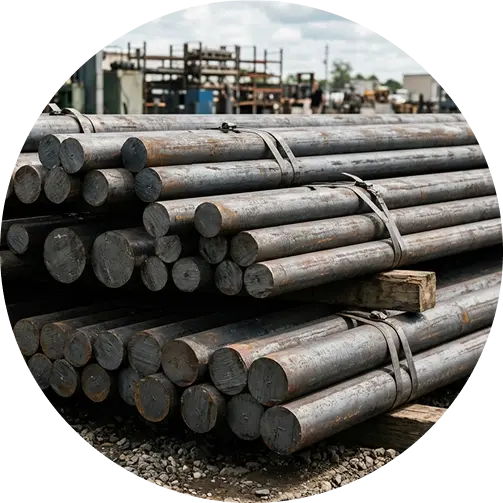
A round bar is a solid circular steel section, but the way it is made changes how it behaves in actual work. Hot-rolled steel round bars are produced by rolling heated steel into round sections, which makes the material easier to form and practical for large-scale industrial supply. In simple terms, hot rolled stainless steel is not bought because it looks refined in raw form. It is bought because it works well in machining, forging, fabrication, and other engineering processes. That is the real reason it remains relevant across workshops, OEM supply chains, and industrial manufacturing. Hot-rolled steel bar references consistently describe these bars as common industrial forms produced from billets or blooms and used across a wide variety of sections and applications.
This also explains why hot rolled round steel bars continue to stay relevant in India. A machine shop may use them as stock for shafts or pins. A forging unit may use them as input for formed parts. A fabrication setup may use them where the final finish will come later in the process. Once the product is viewed through production logic instead of appearance, the selection becomes clearer. The question is not whether the bar looks premium on day one. The real question is whether it suits what the buyer wants to manufacture next.
Meaningful points:
- hot rolled round steel bars are solid circular steel sections used in engineering and manufacturing.
- They are usually selected for process-fit rather than decorative finish.
- They are widely used as base stock for machining, forging, and conversion-heavy jobs.
- They remain useful where the material will later be shaped into a final component.
- They are commercially practical for recurring industrial procurement in India.
How the Hot Rolled Steel Manufacturing Process Works
The hot rolled steel manufacturing process matters because it explains both the look of the product and its industrial value. The process generally begins with semi-finished steel such as billets or blooms. These are heated to a high working temperature and then passed through rolling stands that progressively reduce the section into a round bar. Working the steel while hot allows significant deformation and supports higher production efficiency. After rolling, the material is usually cooled, cut, straightened, and inspected before supply. Standard steel bar references describe hot-rolled bars as being produced from billets or blooms and distinguish this route from more finished bar forms.
For buyers, this process knowledge prevents wrong expectations. A hot rolled bar usually has a more practical, mill-type surface and broader dimensional tolerance than cold-finished stock. That is normal for the route, not a quality failure. In Indian industry, many buyers source steel for further conversion rather than direct visible use, so this difference matters. Better process understanding helps buyers compare the right products, ask better questions, and avoid paying for refinements that their application may not even need.
Key process stages:
- Semi-finished steel such as billets or blooms is used as the starting material.
- The material is reheated so it can be rolled more easily.
- Rolling stands reduce the section into round bar form.
- The bar is cooled, cut, and straightened after rolling.
- Inspection and dispatch follow based on the supply requirement.
- The route is efficient for industrial-scale production.
See Also : Hot Rolled Steel: Common Grades & Industrial Uses
Hot Rolled Steel Bar Properties That Matter in Industrial Use
A lot of buying confusion starts when people assume one answer fits all hot rolled steel bar properties. It does not. Actual performance depends on steel chemistry, grade, section, and how the material will be used later. Even so, there are broad patterns that matter. Hot rolled bars are valued for practical strength, workability, and suitability for downstream processes such as machining and forging. They are not usually selected for ultra-smooth finish or very tight accuracy from the beginning. Bar references also note that more highly finished products can offer improved dimensional accuracy and smoother surfaces than equivalent hot rolled bars.
This is important because industrial steel should be judged by production fit, not just by raw appearance. If the bar is going to be turned on a lathe, forged into shape, or used as input for another process, a highly refined surface at the start may add cost without adding enough value. For Indian buyers balancing technical needs with commercial pressure, that practical view matters a lot. The best material is usually the one that fits the next operation properly, not the one that simply looks more finished in stock form.
What usually matters most:
- Hot rolled steel bar properties depend on grade and end use.
- The surface is usually more practical than premium.
- Dimensional tolerance is typically broader than cold-finished alternatives.
- The bars suit machining, forging, and process-heavy applications well.
- Selection should be based on application, not on finish alone.
- Mechanical usefulness matters more than showroom appearance.
Common Materials and Grades Used in Hot Rolled Round Steel Bars
A round bar is a product form, not one fixed material family. That is why material choice matters so much. carbon steel round bars are widely used because they suit a broad range of industrial and engineering applications at workable cost levels. Alloy steels come into the picture when the job needs better strength response, wear resistance, or heat-treatment behavior. Stainless grades become relevant where corrosion resistance matters. In other words, the size alone is never enough. Buyers need to understand what the part must do in service and what the material will go through after purchase. Steel bar references broadly support this application-led way of selecting bar products.
This distinction matters even more in manufacturing systems where the bar is not always the final market-facing product. Sometimes it is the starting stock for another engineered output. That is why material choice should be discussed together with process route, not separately. In India, buyers who align grade, section, and end use early usually make better decisions than those who focus only on rate first and technical fit later.
What to check before choosing a grade:
- Whether carbon steel round bars are enough for the application.
- Whether alloy steel is needed for a tougher duty cycle.
- Whether stainless becomes necessary in corrosive conditions.
- Whether the material will be machined, forged, or heat treated later.
- Whether the selected grade matches service conditions realistically.
- Whether the supplier’s grade range fits the actual job.
Standard Sizes and How to Understand HR Steel Round Bar Sizes
Size discussions in steel often sound straightforward, but they are not always that simple in real procurement. One buyer may ask for hr steel round bar, another for hot rolled steel rod, and a third may ask only for diameter. These may overlap, but they are not always the same buying conversation. That is why hr steel round bar sizes should be understood together with supply form, straight length, process allowance, and intended end use. Technical references also separate bars, rods, and more finished forms by how they are used and processed, which is why buyers should avoid assuming that every round section quote means the same thing.
This is especially important in the Indian market, where quick quote comparisons are common. Two suppliers may quote similar sizes but on different assumptions about condition, tolerances, or downstream use. That can create mismatch later in machining or fabrication. A better buying approach is to define the requirement clearly from the beginning. Size matters, but so do length, form, grade, and what the material is expected to become next.
Specification points buyers should define:
- Whether the need is for hr steel round bar or hot rolled steel rod.
- What exact hr steel round bar sizes are required.
- Whether the supply is needed as straight bar or another form.
- What machining or process allowance is expected.
- What grade and length are required.
- Whether the quoted product really matches the end-use plan.
Key Benefits of Hot Rolled Round Bars
The biggest advantage of this category is that it fits the logic of actual manufacturing. Many industries do not need the most polished steel input at the first stage. They need a workable, dependable material that can move into the next process efficiently. That is where industrial hot rolled round bars offer real value. They support machining, forging, fabrication, and conversion-heavy operations without pushing buyers toward unnecessary finish cost too early. Technical references also note that cold-finished and polished bar forms are preferred where smoother finish or closer accuracy is needed, which indirectly highlights why hot rolled bars remain practical where those conditions are not essential.
This benefit is highly relevant in India, where industrial buyers often need to balance application suitability with commercial efficiency. A bar that works well in the next manufacturing step is often more valuable than a bar that simply looks better in stock form. That is why hot rolled bars continue to hold a steady place across engineering supply chains, especially in process-driven sectors where the raw stock is only the beginning of the real production journey.
Key benefits:
- Useful for machining, forging, and general engineering.
- Practical cost-to-application balance.
- Suitable where finish is not the first selection criterion.
- Helpful in process-led manufacturing systems.
- Commercially relevant for recurring industrial use.
- Strong fit for conversion-heavy production environments.
Learn : Top 7 Things to Check Before Buying Seamless Stainless Steel Pipes
Industrial Applications of Hot Rolled Round Bars
In India, round bars support a wide range of industries rather than one narrow category of buyers. They are relevant to machine shops, forging setups, fabrication units, auto-component supply, infrastructure-linked manufacturing, and general engineering. Their importance increases when they are used as upstream stock rather than as a final sold component. This matters because a round bar can sit at the start of a much larger production sequence. Once you understand that, the product stops looking basic and starts looking structurally important to industrial output.
Round bars often do more than serve as direct machining stock. In process-led manufacturing, they can also become the starting point for further steel conversion. That makes them relevant not just to fabricators and machine shops, but also to manufacturers like Heavy Metal & Tubes, where industrial steel processing depends on the right input quality, route, and application fit.
Application-focused pointers:
- Used as stock for machining and turning operations.
- Relevant in forging and conversion-heavy manufacturing.
- Important in fabrication and general engineering setups.
- Linked to broader industrial production in India.
- Useful as feed material inside integrated manufacturing chains.
- Often valued for what they help produce next.
Hot Rolled vs Cold Finished Round Bars: What Is the Difference?
This comparison becomes useful only when it stays practical. Hot rolled bars and cold finished bars are not solving the same problem every time. Hot rolled bars are usually the better fit when the material will go through machining, forging, or another secondary operation and when broader tolerance is acceptable. Cold-finished or polished bars are more suitable when smoother surface, closer accuracy, and improved dimensional consistency are required from the start. Technical references explicitly note that turned and polished bars can have similar mechanical properties to equivalent hot rolled bars while offering a smoother bright surface and improved dimensional accuracy.
This matters because many buyers assume the more refined-looking option must always be better. In reality, that can increase cost without improving process results. The right comparison is not which product sounds more premium. It is which product fits the manufacturing route better. For Indian buyers dealing with both price pressure and delivery schedules, that difference affects procurement quality in a very real way.
A practical comparison:
- Hot rolled works well for base stock and further processing.
- Cold finished works better where finish and accuracy matter more.
- Hot rolled is usually more practical for conversion-heavy use.
- Cold finished can reduce downstream finishing needs in precision jobs.
- The correct choice depends on end use, not label appeal.
- Process sequence should guide the decision.
For more : Hot Rolled vs Cold Rolled Stainless Steel
How to Choose the Right Hot Rolled Round Bar Supplier
By the time someone starts looking for a hot rolled steel round bar supplier, the decision is no longer only about the product name. It becomes a question of capability. Buyers need to know whether the source can support the right grade, the right size band, the right consistency, and the right industrial understanding. That is especially true in India, where supply continuity, application fit, and commercial clarity can matter as much as basic availability. A good supplier does not just quote. A good supplier understands what the bar is expected to do next.
That is why supplier evaluation should stay practical. Buyers should compare grade support, size support, clarity on condition, and whether the supplier understands the process route behind the requirement. In industrial steel, a source that matches the application properly is usually more valuable than one that only markets itself aggressively.
What buyers should check:
- Grade and size support.
- Clarity on actual supply conditions.
- Relevance to the intended application.
- Process understanding, not just sales language.
- Ability to support recurring industrial demand.
- Whether the offered product truly matches the requirement.
What to Check Before Buying from a Manufacturer in India
A supplier and a manufacturer are not always the same thing, and that distinction matters in B2B steel buying. When evaluating the best hot rolled round bar manufacturer in India, buyers should not rely only on broad claims. They should check whether the manufacturer has real process depth, material understanding, and suitability for the application at hand. In process-driven sectors, that matters far more than generic wording. Indian buyers also need to consider documentation clarity, manufacturing seriousness, and whether the manufacturer’s product scope aligns with actual industry use.
When buying from a manufacturer, the real question is not only what products are listed, but how strong the production understanding is behind them. In industrial steel, that difference matters because the right material has to suit the next stage of manufacturing as well. That is the kind of context in which Heavy Metal & Tubes fits better here, as a manufacturer linked to process-driven steel production rather than just routine supply.
Before buying from a manufacturer in India, check:
- Whether the manufacturer’s product scope truly fits your application.
- Whether grade and size support are aligned with your requirement.
- Whether the manufacturing route matches the material use-case.
- Whether documentation and consistency are taken seriously.
- Whether the source understands downstream processing needs.
- Whether the supply is suitable for long-term industrial use.
Conclusion
A hot rolled round bar remains important because it fits the way industry actually works. It is a practical steel input that supports machining, forging, fabrication, and integrated manufacturing without forcing buyers to overpay for the wrong kind of finish at the wrong stage. That is why the category remains commercially and technically relevant across Indian industry. The value of hot rolled round bars is not only in what they are as stock. It is in what they help produce next. When buyers understand that clearly, material selection becomes smarter, cleaner, and more useful.