Steel Tube Explained: Carbon Steel, Alloy Steel & Stainless Steel Comparison
09/ Jul, 2026
When you first see a steel tube, it may look the same, like the same shine, same shape, same structure, etc. But once you use it for your work, at that time you realise that they are all very different. One may rust in a few months, another tube can stand strong in extreme heat, or the other will be less costly and still perform surprisingly well and do its job perfectly.
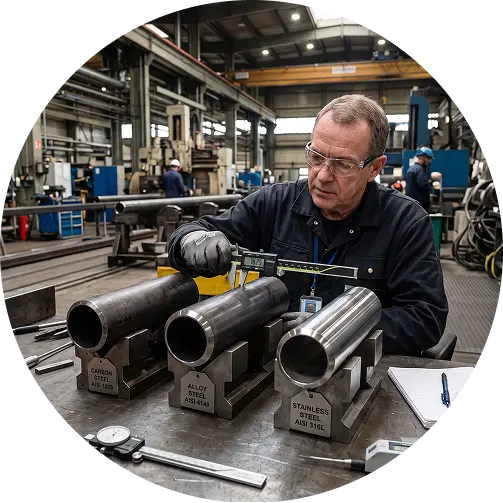
The secret is not the shape of the tube, but it's the type of steel that's being used inside it.
At Heavy Metal, we work with steel and tubes every day, so we want to explain this in the simplest way possible. First things first, there are three main types of steel in the market: carbon steel, alloy steel, and stainless steel. Each one of them has their own strengths and their own best usage.
In short, the carbon steel tubes are the strongest ones, and they are low-cost as well. Alloy steel tubes are best for industries who work in heat and pressure, because it works great in these industries. Stainless steel tubes are best for fighting rust, and it lasts a very long time. Many industries pick different ones based on their work preference and depending on the job. Factories, power plants, oil and gas sites, food units, and construction projects all choose based on what they need.
When you finish reading this guide, you will know about the differences between the types of tubes, the areas of application, and how to find a suitable tube for your project. There won’t be any engineering jargon, only easy and understandable information.
What Is a Steel Tube?
Definition and Manufacturing Process
Start with the basics. A steel tube is a hollow steel bar with a fixed width and a fixed wall thickness. Its job is to move liquid or gas, carry heat, or hold weight. Nothing exotic.
The one thing that sets a tube apart is how precisely it is made. These are exact items. That precision is the reason you find them tucked inside boilers and heat exchangers, machines where a size that drifts even a little starts causing real headaches.
Now, how they are made. There are two routes, and they matter. Push a hole clean through a solid piece of steel and you get a seamless tube, one with no joint anywhere, which is why it takes high heat and high pressure so well. Roll a flat sheet and weld the edges together instead and you get a welded tube. Cheaper. And for ordinary work, perfectly good.
Common International Standards
Standards are just rulebooks for steel. They exist so a tube made here does the same thing on a site halfway across the world. You will see ASTM and ASME most, then EN, DIN, and JIS depending on the project. The takeaway is short. Insist on a tube that meets a real standard, and get the certificate that backs it. That paper is your protection.
Types of Steel Tubes
"Steel tube" is not one single product. Tubes are grouped a few different ways, and it helps to know them before you pick a material, because the type often matters as much as the steel itself.
The first and biggest split is how the tube is made.
Seamless tubes:
These start as a solid bar of steel that gets pierced right through the middle to form the hollow. No seam, no weld line, nothing to give way. That is why seamless tubes are the go-to for high pressure and high heat, the kind of duty you see in boilers and heat exchangers. They cost more, but in demanding spots they earn it.
Welded tubes:
Here, a flat strip of steel is rolled into a round shape and the edges are joined with a weld running along the length. Faster to make and easier on the budget. For everyday, lower-pressure jobs, a good welded tube does the work without any fuss.
Then there is a split by how finely the tube is finished.
Cold drawn (precision) tubes:
These are pulled cold through a die to tighten the size and smooth the surface. The result is a very accurate, very consistent tube, which is what precision work needs. At Heavy Metal, we run a dedicated plant just for cold drawn carbon and alloy steel tubes, exactly for jobs where the size has to be spot on.
Standard tubes:
Made to normal commercial tolerances. Perfectly fine for general use where a tiny size variation does not change anything.
There is also shape and end-form to think about. U-bend tubes, for example, are bent to precise curves for heat exchangers, boilers, and condensers, a job we do across carbon, alloy, and stainless steel.
And finally, tubes are grouped by the material inside them, which is the part most people mean when they compare tubes. That is carbon steel, alloy steel, and stainless steel, and it is where the real decision usually sits. So that is what we will unpack next, one at a time.
Understanding Carbon Steel Tubes
What Is Carbon Steel?
This is the plain one. Mostly iron, a pinch of carbon, and that is about it. It is the cheapest of the three and, for the money, seriously strong. There is a catch, though, and it is the whole personality of carbon steel: no chromium means it rusts the moment water gets to it.
Types of Carbon Steel
It comes in three flavours, sorted by how much carbon is inside. Low carbon is the soft, friendly one, easy to bend, easy to weld, the workhorse of general jobs. Medium carbon gives up a bit of that ease for extra strength and hardness. High carbon is the toughest of the lot, but it fights you when you try to weld or shape it, so it stays in specialist roles.
Key Properties
Why do people keep reaching for it? A few reasons. It is strong. It cuts and shapes without trouble. It is cheap, sometimes shockingly so next to the other two. And it holds up under pressure, which is exactly why boilers and pipelines lean on it. The one thing you can never forget is rust. Keep carbon steel dry, or give it a coat of paint or coating, and it stays out of trouble.
Common Grades
Three carbon grades cover most tube work. A179 for heat-exchanger and condenser tubes. A192, a boiler tube made for high pressure. A210 sits a notch above that, a stronger boiler and superheater tube. And the mix-up people make over and over: those are tube grades. A106 and A53 get named right alongside them, but they are pipe grades, so keep them off a tube order.
Typical Applications
Where does it end up? Anywhere strength and price beat rust worries. Oil and gas work. Water lines. Boilers. Building frames. General construction. As long as the setting is dry and free of chemicals, carbon steel earns its keep and costs you little.
Learn More: Guide to Choose Best Carbon Steel Seamless Tubes
Understanding Alloy Steel Tubes
Now for the specialist. Alloy steel starts as ordinary carbon steel, then gets a few carefully chosen ingredients mixed in. Those small additions and its abilities plain carbon steel simply cannot manage, and the aim behind them almost never changes. Stay strong when it gets fiercely hot. Stay reliable when the pressure climbs. That is the brief, every time.
Common Alloying Elements
Each ingredient pulls its weight. Chromium brings strength plus a little rust protection. Molybdenum is the heat hero, the reason the popular grades all carry it. Nickel adds toughness. Vanadium tightens the grain and lifts strength again. Manganese chips in on hardness. None of it is thrown together. Every recipe is worked out for the exact conditions the tube will face.
Key Properties
Everything about alloy tubes points at the hard cases. Strong when hot, steady under pressure, more resistant to wear than plain carbon, and just plain strong overall. That is precisely the mix a boiler or a high-heat machine needs, and it is also why you pay more for it than for carbon.
Popular Grades
The ones to know all live in the chrome-moly family under ASTM A213. T11 and T22 take most boiler and heat-exchanger work. Need more chromium? T5 and T9. T91 is built for the hottest, highest-pressure spots in a power plant. Spotted P11 or P91 somewhere and wondered? Same steel, just written the pipe way. On the tube, go with the T.
Typical Applications
Alloy tubes live in the high-heat, high-pressure world. Refineries. Petrochemical plants. Power stations. Heat exchangers. Pressure vessels. Put plain carbon steel in those spots and it slowly gives up. Alloy steel does not, so that is where it goes.
Learn More: What Is Alloy Steel? Composition, Types, Grades & Applications
Understanding Stainless Steel Tubes
Stainless is the rust fighter, and the trick behind it is chromium, usually about 10.5 percent or more of it. That chromium builds a thin, invisible layer across the surface that keeps rust out. The best part? Scratch that layer and it repairs itself. Which is exactly why, anywhere rust or cleanliness genuinely matters, stainless is the first name on the list.
Stainless Steel Families
Here is something people miss. Stainless is not one material but a small family of them. Austenitic is the common one in tubes, great at resisting rust and easy to shape. Ferritic is cheaper, magnetic, and okay rather than brilliant on rust. Duplex blends two structures to hand you high strength and strong salt resistance together. And martensitic is the hard one, picked when strength and wear beat out full rust protection.
Key Properties
Line stainless up against carbon steel and it reads almost like a mirror image. No coating needed, it fights rust on its own. Clean and easy to wash, which food and medicine absolutely demand. Comfortable in heat. Smart-looking, with that clean, bright finish. And it goes the distance, often decades, asking for barely any attention along the way.
Popular Grades
It comes down to a short list. SS 304 and 304L for everyday rust protection. SS 316 and 316L once salt water or harsh chemicals show up. SS 321 when the heat runs high. Duplex 2205 for jobs needing strength and salt resistance at once. Those "L" grades are just the low-carbon versions, picked when plenty of welding is coming. Most of it falls under ASTM A213 and A269.
Typical Applications
Stainless goes where rust and dirt are simply not allowed. Food processing. Medicine and pharma. Ships and the coast. Chemical plants. Water treatment. And when those settings turn truly brutal, 316 and duplex are the ones doing the hard graft. As a stainless steel tubes manufacturer, we make these grades in both seamless and welded form, matched to the job.
Learn More: Stainless Steel Tubing: Complete Buyer’s Guide for Industrial Applications
Carbon Steel vs Alloy Steel vs Stainless Steel
One table, everything side by side. Keep this in mind as you read it: none of them is "the best." The best is whichever one fits your job and your budget.
| Feature | Carbon Steel | Alloy Steel | Stainless Steel |
|---|---|---|---|
| Strength | High | Very high | High |
| Rust resistance | Low, needs protection | Low to moderate | Very high |
| Heat resistance | Moderate | Excellent | Good to excellent |
| Cost | Lowest | Medium to high | Highest |
| Easy to weld | Yes | Needs care | Yes |
| Easy to machine | Yes | Moderate | Moderate |
| Maintenance | Higher | Moderate | Low |
| Lifespan | Good if protected | Long in high heat | Very long |
| Best industries | Construction, oil and gas, water | Power, refineries, petrochemical | Food, pharma, marine, chemical |
Run your eye down each column, and they sort themselves out. Carbon, the budget pick, at home anywhere dry. Alloy, the heat-and-pressure specialist. Stainless, dearest to buy, cheapest to keep, and the one still going years down the line.
Which Steel Tube Is Best for Your Industry?
The answer shifts sector by sector, so here is the fast version.
Oil and gas run mostly on carbon and alloy, then switch to stainless or duplex the moment a stream turns harsh. Petrochemical plants use alloy through the hot units and stainless where the chemicals bite. Construction? Mostly carbon, because strength and cost win the day. Marine and coastal work has to go stainless, usually 316 or duplex, since salt air chews through ordinary steel fast. Power plants put alloy in their boilers, where heat is the whole challenge. Food, drink, and pharma all insist on stainless for cleanliness. And automotive relies on precise carbon and alloy tubes for parts that have to fit exactly right.
How to Choose the Right Steel Tube
It is simpler than it sounds. Run through a handful of questions, and the answer usually picks itself. How hot will it get? How much pressure? Any risk of rust or chemicals? How strong does it really need to be? What is the budget, and how long do you want it to last?
Then match those to a material. Heat and pressure point you to the alloy. Rust and cleanliness point you to stainless. Strength on a tight budget in dry conditions points you to carbon. If you want the full step-by-step version, our guide on choosing the right steel tube for industrial applications walks through each point.
Learn More: How to Choose the Right Steel Tubes for Industrial Applications: Complete Buyer's Guide
Why Quality Matters When Buying Steel Tubes
A tube is not just its steel. It is also proof that the steel is what someone claims it is. Material certificates and Mill Test Certificates spell out exactly what the metal is made of. Inspections and tests confirm the tube is actually sound. Accurate sizing, a clean surface, honest traceability, those are what separate a tube you can trust from one you are gambling on. And all of it means nothing if the supplier cannot stand behind it, which is why choosing a supplier you trust is part of the quality, not a side issue.
Why Choose Heavy Metal for Steel Tubes?
For all the theory, it still comes back to one question. Who actually makes and supplies your tube? That is where Heavy Metal & Tubes (India) Pvt. Ltd. comes in.
Four decades-plus of experience, three factories in Gujarat, and a large stock of carbon, alloy, and stainless steel tubes across a wide range of grades and sizes, in both seamless and welded types. We take them from the raw steel bar right through to the finished tube, in lengths up to 34 metres. Everyone is built to international standards, ASTM, ASME, DIN, JIS, BS, IS, and GOST, and comes with full test certificates and traceability. Our tubes are trusted and approved by major EPCs, PMCs, consultants, and OEMs across oil and gas, refineries, power, chemical, pharma, and fertilizer plants.
Being a stainless steel tubes manufacturer, a carbon steel tubes manufacturer, and an alloy steel tubes manufacturer all under one roof means we can help you land on the right grade, size, and type for your job, take on custom needs, and back it with fair pricing, on-time delivery, export support, and real technical help. To talk through a requirement, write to info@hmtl.in.
Conclusion
Carbon, alloy, and stainless steel tubes are not rivals so much as specialists, each built for a different fight. Carbon is strong and cheap for dry, safe settings. Alloy is made for heat and pressure. Stainless resists rust and lasts the longest of all. Which one is right comes down to your heat, pressure, rust risk, and budget. Choose it well and you protect safety, keep things running, and cut your long-term costs. Get the grade right, buy from someone who can prove quality, and the tube will do its job for years without a fuss. Working with an experienced maker like Heavy Metal is the simplest way to be sure the tube on paper is the tube that turns up on site.