Why Surgical Equipment Manufacturers Prefer Precision Stainless Steel Tube?
10/ Aug, 2026
When it comes to a component being placed into surgical equipment, there really isn’t a lot of opportunity to get “close.” A stainless steel tube might have very strict standards that it has to meet in terms of diameter, wall thickness, surface finish, strength, corrosion resistance, etc. Even the smallest deviation from these can influence how the component interacts.
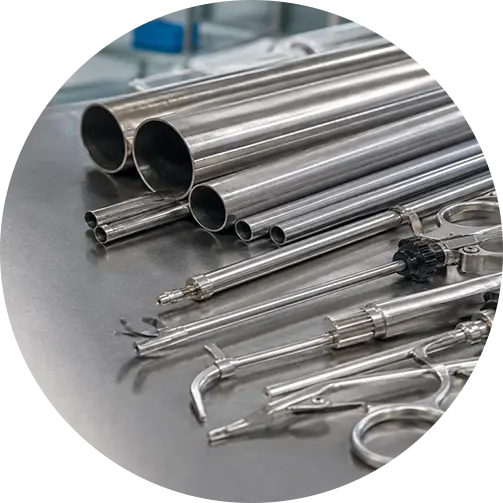

“In medical equipment manufacturing, precision is not a finishing detail; it is part of the product itself.”
Therefore, tubing is very important for manufacturers. The tubing would have to be robust enough for the machining processes, cleaning, sterilization, and for multiple uses depending on the device application. In the case of medical devices and stainless steel surgical instruments, consistency is as key as for other manufacturing components like the tubing material, although of course precision is important for other reasons.
What Is a Precision Stainless Steel Tube?
A precision tube refers to a tube manufactured to a more exacting dimension and surface condition than a standard tube. The outer diameter, bore, wall thickness, straightness, and surface finish are controlled depending upon the application.
Precision stainless steel tubes can be manufactured using either a seamless or welded method, and can also be cold drawn, annealed, straightened, and finished to the required specification.
The selection of an appropriate tube is governed by the form of the final product. There is no 'all-purpose' stainless steel grade or method of manufacture for medical uses.
Example: ISO 9626 specifies the requirements and tests to which rigid stainless steel needle tubing for medical purposes must adhere. This exemplifies the control over dimensions and mechanics that may be demanded.
Why Precision Matters in Surgical Equipment Manufacturing?
In surgical equipment, dimensional accuracy is not simply a manufacturing preference. It can affect assembly, movement and the performance of the finished device.
Dimensional Accuracy
A tube that fits inside another component needs a controlled outside diameter. Similarly, when it forms a passage, its internal diameter and wall thickness can affect how the component functions.
Tight tolerances therefore become important, particularly for small and closely fitted assemblies.
Surface Quality
Surface condition also matters. A smooth and consistent surface can support cleaning, finishing and further processing. For reusable equipment, this becomes particularly relevant because the component may be exposed to repeated cleaning and sterilization.
Batch-to-Batch Consistency
It is not enough for manufacturers to have a single good batch. They are going to have a reliably good batch.
Predictable dimensions and material characteristics also greatly simplify part feeding and minimize variations throughout the assembly process.
How Are Precision Stainless Steel Tubes Manufactured?
The manufacturing route depends on the grade, dimensions, application and required specification.
For seamless products, a solid billet is converted into a hollow and then processed further to reach the required dimensions.
Cold Drawing and Finishing
Cold drawing produces a reduction in tube dimensions, improves control of dimensions and finishes, and can incorporate subsequent operations of heat treatment, straightening, cutting, and surface finishing, as required.
These processes are vital to obtain the control of dimensions required by the customer for precision applications.
Inspection and Testing
The manufacturing process also includes inspection. Depending on the specification, this can involve dimensional checks, chemical and mechanical testing, hydrostatic testing or non-destructive testing.
For medical applications, the important point is consistency: the finished tube needs to meet the agreed requirements from batch to batch.
Why Surgical Equipment Manufacturers Prefer Stainless Steel Tubes?
Stainless steel possesses a useful balance of properties for several medical and surgical devices, making it a preferred material for many applications. Steel tubes suppliers provide different stainless steel grades to meet specific requirements for strength, corrosion resistance, and formability.
Surgical stainless steel isn’t a single category but includes several alloys that vary in their corrosion resistance, formability, hardness, and strength.
Corrosion Resistance
Medical devices may come into contact with liquids, disinfectants, and the sterilization environment. A stainless steel grade to provide protection is ideally suited
Strength and Stability
A tube could be thin-walled but still required for holding the shape, also in assembling as well as during operating a device. Mechanical and physical properties can be tailored through material choice and subsequent processing techniques.
Cleanability
A properly finished stainless steel surface can be easier to clean and maintain, which is particularly relevant to reusable equipment.
“When a component has to perform repeatedly, consistency becomes just as important as strength.”
This is one reason manufacturers consider not only the steel grade but also tube manufacturing, finishing, and inspection.
Common Stainless Steel Grades Used in Surgical Equipment
In selecting a material, a grade common in our experience should not be used, but instead a grade selected based on its use.
Austenitic Stainless Steels
Generally speaking, all austenitic grades excel in terms of corrosion resistance and are easily formable. Austenitic steel of the 304 and 316 grades is routinely used in engineering applications; the choice depends on the item.
Martensitic Stainless Steels
Some martensitic grades can provide higher hardness and strength after heat treatment. This makes them useful for particular components where hardness, wear resistance, or edge retention is important.
This is why the material used for stainless steel surgical instruments may differ from the material selected for a tubular component.
Implant Applications
Implant materials have their own requirements and should not automatically be treated as equivalent to general medical equipment materials. The applicable standard and finished-device requirements need to be confirmed before selection.
Applications of Precision Stainless Steel Tubes in Surgical Equipment
Precision tubing can be used in several types of medical equipment and components, depending on the design.
Medical Device Tubing
Small-diameter tubing can be used where controlled dimensions and mechanical properties are required. Needle tubing is one example of a medical application covered by specific standards.
Surgical Instruments
Tubular sections can contribute to shafts, handles, and associated assemblies for equipment. Precision in overall dimensionality, rigidity of form, and resistance to surface and external corrosion are all elements to consider.
Fluid and Gas Handling
Some medical equipment uses tubing for controlled movement of fluids or gases. In these cases, internal dimensions and surface condition can become particularly important.
Diagnostic and Laboratory Equipment
Precision tubing may also be used in equipment where repeatable dimensions and resistance to cleaning environments are required.
Learn More: Stainless Steel Tubing: Complete Buyer’s Guide for Industrial Applications
Essential Properties Required in Medical Grade Stainless Steel Tubes
The right surgical steel tube needs to meet more than a material-grade requirement.
Dimensional Precision: Outside diameter, inside diameter, and wall thickness need to remain within the specified tolerances.
Corrosion Resistance: Ideally, the material would be compatible with all chemicals, moisture, cleaning agents, and sterilization conditions present for your application
Mechanical Strength: The tube should withstand the forming, machining, assembly and service conditions expected from the finished device.
Surface Finish: Surface condition can affect cleaning, further processing and corrosion performance.
Traceability: For tightly controlled applications, material identification and test documentation can be important parts of quality management.
Industry Standards and Certifications for Medical Stainless Steel Tubes
There’s not one single certification that will make any given tube perfect for all uses in the medical field. The specific applicable standard will be based on the intended end-use of the tube. For example, ISO 9626 is the standard for rigid stainless steel needle tubing intended for medical devices.
ASTM F899 describes the requirements for wrought stainless steels intended for surgical applications.
So for a manufacturer, the critical question isn’t simply whether a material will need to be stainless steel. It is whether the tube meets the material, dimensional, mechanical, surface and testing requirements of the intended application.
Challenges in Surgical Equipment Manufacturing and How Precision Tubes Solve Them
Medical equipment manufacturers must be able to preserve exact uniformity while handling and processing minuscule components that are many times more complicated in structure of steel tubes.
Tight Tolerances - Manufacturers work in tight confines for higher-yield assembly and greater repeatability by utilizing precision tubing.
Repeated Cleaning and Sterilization - Material and surface selection need to account for repeated exposure to cleaning and sterilization conditions where applicable.
Corrosion Concerns - Select the right stainless steel grade as well as having to deal with appropriate surfaces should sort this problem.
Complex Designs - Tubes may need to be cut, bent, formed, machined or joined. Consistent dimensions make these secondary operations easier to control.
How to Choose the Right Stainless Steel Tubes for Surgical Equipment Manufacturing?
The steel tube selection should begin with the finished device and its operating conditions.
Define the Application
Consider whether the tube will contact fluids, face cleaning chemicals, undergo sterilization, or experience pressure and bending.
Specify Dimensions
166 clearly defines dimensions such as outside diameter, inside diameter, wall thickness, and length, as well as tolerance parameters. Surface finish and straightness are to be specified.
Confirm the Standard
The applicable material and product standard should be agreed upon before production. This prevents confusion between general industrial tubing and tubing intended for a specific medical application.
Look Beyond Price
Price matters, but manufacturing control, testing, traceability, and the ability to meet customer-specific requirements can be equally important.
Why Choose Heavy Metal & Tubes for Stainless Steel Tubes in India?
In choosing a tube supplier, an equipment manufacturer must go deeper than the catalogue.
Heavy Metal & Tubes (India) Pvt. Ltd. boasts over four decades of experience manufacturing stainless steel, carbon steel, and alloy steel tubes and pipes, operating facilities in Gujarat, and producing according to national and international standards or specific client requirements.
The group will manufacture all categories of stainless steel, seamless, welded tubes and pipes with complete manufacturing and testing support.
The combination of manufacturing expertise and an extensive knowledge pool should also add value for firms that require stringent dimensional requirements, tight specifications or material certification from their steel tubes suppliers.

Conclusion
Manufacturers are not specifically picking a piece of precision tubing because stainless steel is common in the medical field. This application of the precision tubing is more specific to its qualities.
The tube possibly would need to have very tight dimensions, good mechanical properties, and enough strength in order to withstand its medical use, corrosion, a specific finish, and traceability. It will probably have the capability of cleaning, sterilizing, and possible repetitive cleaning procedures.
This is why precision stainless steel tubes have importance when it comes to making surgical tools. By using this precision stainless steel tubing, the manufacturer will have more control over the part that is part of a larger tool.
But for producers of medical devices and stainless steel surgical instruments, nothing else is more important than reliability. A tube that repeatedly comes in within the specification can be worked and controlled easier, a tube you don't need to consider as much when the part will be built.
So, picking the correct manufacturer is almost as important as picking the correct material.